Understand the why, not just the recipe.
Honest, tested guidance from the people who pack your kits — fundamentals, troubleshooting and the small details that turn a guess into a craft.
Salt by weight: the one number that matters
Master percentages once and every vegetable ferment becomes reliable. We break down the 2% rule, why it works, and how to never guess a brine again.
Read the guideStart at the beginning, or pick a craft
Sequenced lessons that build real confidence — each pairs with kits and the Madre app.
Fermentation foundations
Salt, time, temperature and safety — the four levers behind every ferment.
Vegetables & krauts
From sauerkraut to kimchi and curtido — texture, sourness and crunch, controlled.
Wild fizz & brews
Kombucha, water kefir and wild sodas — a healthy culture and a reliable second ferment.
From the journal
Good sour or bad: how to read your jar
Tell healthy activity from the rare real problem — by sight, smell and taste.
A small-kitchen fermentation cellar
Temperature, light and a single shelf — host living food in any flat.
A starter schedule that fits real life
Feed less, bake better — keep a healthy culture without it ruling your week.
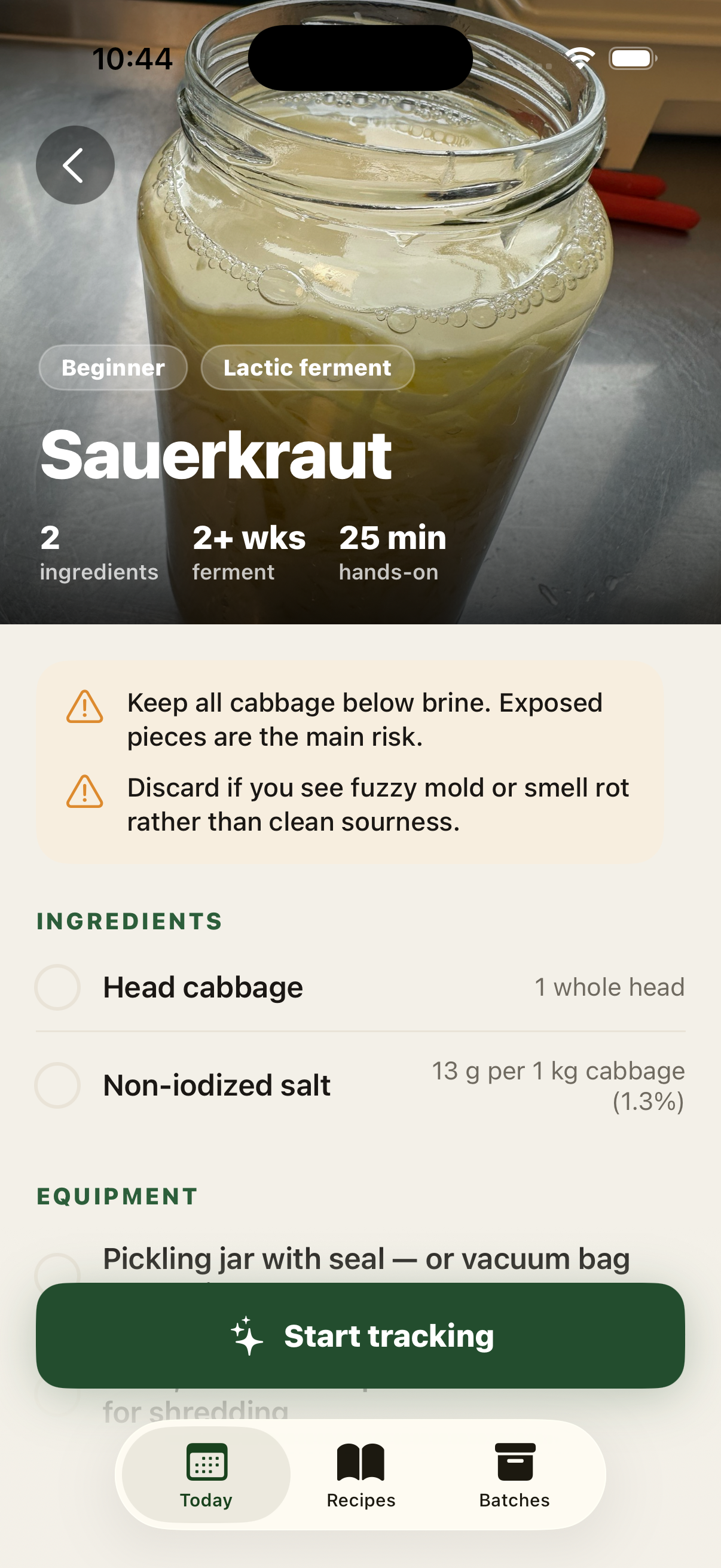
The guide that cooks alongside you
Reading builds understanding; the Madre app builds the habit. Every SYRE kit unlocks guided, hands-free batches — cook-mode steps, calculators and progress tracking, free for the life of your kit.
A fermenter’s shorthand
- Brine / braɪn /
- A salt-and-water solution that selects for the good microbes and keeps everything else out.
- Lacto-fermentation
- The lactic-acid process behind kraut, kimchi and pickles — sour, safe and alive.
- SCOBY
- The culture of bacteria and yeast that turns sweet tea into kombucha.
- Koji
- Grain cultured with Aspergillus oryzae — the foundation of miso, shoyu and amazake.
- Second ferment
- A sealed, sugar-fed stage that builds natural carbonation and fizz.
- Kahm yeast
- A harmless white film — not mould. Skim it, and read our guide if unsure.